The New Default. Your hub for building smart, fast, and sustainable AI software

Table of Contents
AI is transforming DevOps and CI/CD by automating repetitive tasks, improving code quality, enhancing security, and optimizing resource use. Market leaders like Netflix, AWS, and Azure are all moving toward AI-optimized delivery pipelines – and the data shows teams that adopt AI consistently outperform those that don't.
Executive Summary
AI has moved from an experimental addition to a foundational component of modern DevOps practice. The three meaningful shifts: AI now handles test generation, anomaly detection, and deployment rollbacks with minimal human intervention; it enables self-healing pipelines that proactively detect and resolve issues; and it's beginning to act as an intelligent teammate across the entire software development lifecycle, from planning to deployment. The companies investing in AI-augmented DevOps today are building capability that compounds – and the gap between them and teams still running traditional automation is widening.
AI Adoption in DevOps and CI/CD is Rising
GitHub surveyed 2,000 software development professionals across the US, Brazil, India, and Germany in 2024 and found that upwards of 97% had used generative AI tools at some point both in and outside of work. On the DevSecOps side, GitLab's Global DevSecOps Report – drawing on 5,000+ professionals in 39 countries that same year – found that 78% were either already using AI in software development or planned to within the next two years.
The business case is becoming clear. A survey by Techstrong Research and Tricentis found that mature DevOps teams that have adopted AI are significantly more likely to rate their teams as very or extremely effective. The generative AI in DevOps market, valued at approximately $1.87 billion in 2024, is projected to reach $47.3 billion by 2034 – a trajectory driven by the scale of productivity gains teams are reporting.
The core value AI adds to DevOps pipelines comes through three channels. Automation of repetitive tasks accelerates release cycles with fewer errors and higher code quality. Continuous vulnerability detection and compliance monitoring enhance security. Dynamic scaling and prediction of workflow demands optimize resource use.
For teams that haven't yet adopted AI in DevOps, use cases such as AI-powered testing or anomaly detection are practical starting points. From there, integration can scale effectively with good data hygiene and model transparency as guiding constraints.
Why AI is a Game-Changer for DevOps and CI/CD
DevOps has evolved through three phases: manual scripting to automate repetitive tasks, then automated pipelines for continuous integration and delivery, and now intelligent automation powered by AI. The shift from the second to the third phase is more significant than it might appear.
Traditional scripting and rule-based automation are deterministic – they execute exactly what they're told. AI is adaptive. It continuously learns from operational data, identifies patterns, predicts failures and enables systems to detect and resolve issues autonomously.
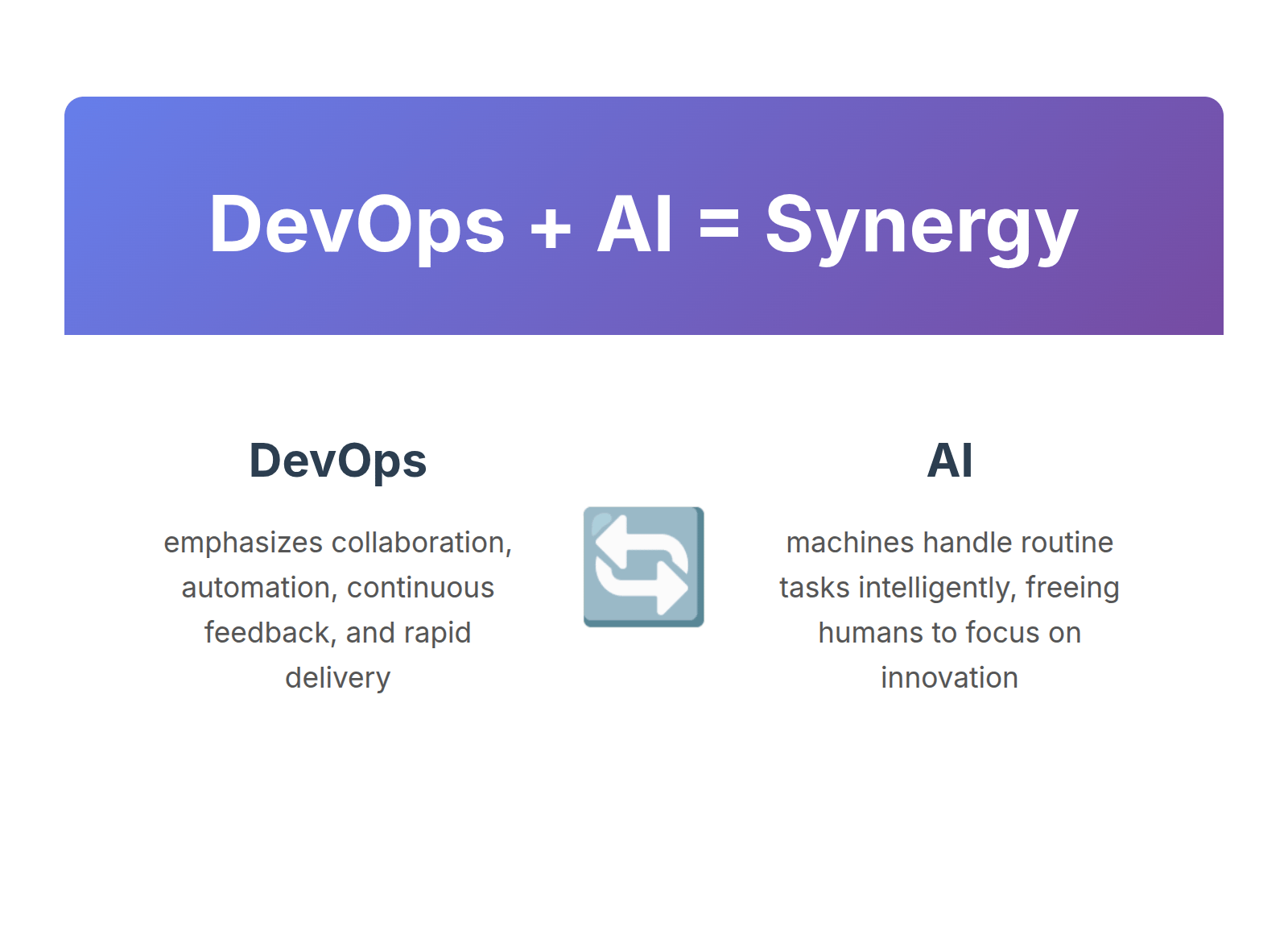
The synergy between DevOps principles and AI is natural: both are built on continuous feedback, iterative improvement, and data-driven decisions.
The principles of AI in DevOps
Five principles define how AI functions in modern DevOps.
An automation-first mindset prioritizes intelligent automation to reduce manual effort and accelerate delivery.
Continuous learning and feedback loops enable AI to analyze pipeline data and iteratively improve processes.
Data-driven decision making uses predictive analytics to optimize deployments and resource management.
Trust and explainability ensure AI models are transparent and their decisions are understandable to maintain team confidence.
And security by design embeds AI-powered monitoring and anomaly detection throughout the lifecycle.
How AI Improves DevOps Pipelines
AI transforms DevOps pipelines through efficiency gains, quality improvements, cost optimization, and security enhancements.
Increased efficiency and automation. AI automates repetitive and time-consuming tasks – code validation, test execution, deployments – reducing manual effort and human error while enabling faster release cycles. AI-powered CI/CD tools intelligently prioritize build jobs, automatically resolve conflicts, and perform rollbacks when anomalies are detected.
Improved software quality and reliability. AI-powered static code analysis identifies bugs and security vulnerabilities early. It detects performance bottlenecks and predicts failures by analyzing historical data and system metrics. AI-driven monitoring enables self-healing pipelines that automatically address issues with minimal human intervention.
Cost optimization through smart resource allocation. AI manages cloud resources intelligently, using predictive analytics based on historical usage patterns to auto-scale resources and avoid over-provisioning. AI-driven capacity planning ensures infrastructure is used efficiently without manual tuning.
Enhanced security and compliance. AI continuously monitors codebases and runtime environments for vulnerabilities and compliance violations. It detects anomalies that may indicate security threats faster than rule-based systems, enabling teams to identify and remediate risks without slowing development.
How AI Transforms Each Stage of the CI/CD Pipeline
Throughout the pipeline, AI introduces intelligent automation and predictive capabilities that make teams more resilient and efficient.
Phase 1: Plan & Code. AI-powered code review tools automatically analyze code changes, identify potential bugs and security vulnerabilities, and suggest improvements. NLP techniques analyze comments and documentation to ensure clarity, helping developers maintain high-quality codebases from the start.
Phase 2: Build. AI predicts potential build failures using historical data, enabling teams to address issues before they cause delays. Intelligent build optimization helps prioritize and parallelize build tasks, reducing overall build times.
Phase 3: Test. AI generates targeted test cases that cover critical code paths, increasing coverage while reducing redundant tests. It detects flaky tests and prioritizes them for review, keeping test suites reliable without slowing down deployment cycles.
Phase 4: Release & Deploy. AI models predict the likelihood of deployment success by analyzing past deployment data and current system conditions, enabling safer releases. In case of anomalies detected through real-time telemetry, automated rollbacks can be triggered immediately to minimize downtime.
Phase 5: Operate & Monitor. Post-deployment, AI continuously monitors logs and system metrics to detect anomalies, performance degradations, or security threats. Self-healing pipelines use this data to fix issues with minimal human intervention. Continuous security scanning ensures deployed applications remain secure and compliant throughout their lifecycle.
What Are the Types of AI Technologies Used in DevOps
AI in DevOps encompasses several distinct technologies, each addressing different parts of the delivery lifecycle.
Machine Learning is the backbone of many AI-driven enhancements – powering test automation by learning from past results, enabling predictive analytics that forecast pipeline failures, and optimizing resource allocation by analyzing historical usage patterns to scale infrastructure dynamically.
Natural Language Processing improves collaboration and code quality by interpreting user stories, analyzing code comments, and enhancing documentation. NLP also supports automated code reviews by understanding the context and intent behind code, making suggestions that go beyond syntax to improve maintainability.
Chatbots and Virtual Assistants are increasingly integrated into DevOps workflows to streamline incident management and support. Tools like Kubiya show how conversational AI enhances developer productivity by automating routine interactions and workflow navigation.
Computer Vision enables visual testing and UI verification. AI-powered visual inspection automatically detects UI inconsistencies, layout issues, or visual regressions at a scale and consistency that manual testing can't match.
Use Cases of AI in CI/CD Pipelines
Intelligent Test Automation is one of the most impactful applications. AI generates test cases automatically, focusing on critical code paths and reducing manual effort. Machine learning further supports regression testing and test impact analysis by identifying which tests to run based on recent code changes.
Predictive Analytics and Release Forecasting – AI models trained on historical pipeline data predict potential delays, failure probabilities, and bottlenecks. This foresight allows teams to proactively mitigate risks and allocate resources more effectively.
Self-Healing CI/CD Pipelines – AI automatically detects and resolves common issues such as misconfigurations or flaky builds. AI-driven monitoring tools like Datadog predict system failures and trigger automated remediation steps, reducing Mean Time to Resolution (MTTR) and minimizing human intervention.
Smart Build Optimization – Machine learning prevents redundant builds by caching results and predicting build outcomes before they are initiated. Tools like Google's Bazel support parallel builds and efficient resource use.
Predictive Deployment and Automated Rollbacks – AI monitors deployments in real time, predicting success rates and automatically rolling back changes if anomalies are detected. This is especially effective in canary and blue-green deployment strategies.
Continuous Security and Compliance Checks – AI enforces security policies and detects vulnerabilities throughout the build and deployment stages, ensuring regulatory compliance and reducing security risks.
Dynamic Resource Management – AI forecasts pipeline needs and adjusts compute resources, optimizing cloud infrastructure costs while maintaining performance.
Code Quality Automation – AI tools analyze code for bugs, style issues, and inefficiencies, providing actionable feedback to improve maintainability and reduce technical debt.
How Big Tech Companies Use AI in DevOps
Three companies illustrate three distinct waves of AI adoption in DevOps.
1. Netflix Auto Remediation
Netflix's Auto Remediation system evolved from a rule-based error classification service called "Pensive" to a machine learning-powered system for automatically handling job failures in their big data platform.
At Netflix's scale – hundreds of thousands of workflows and millions of jobs running daily – even a small percentage of failures creates significant operational burden. The ML-powered system reduces the need for manual intervention by automatically handling issues that previously required joint effort across multiple teams: users, support engineers, and domain experts.
As Netflix detailed in their blog, the system has been deployed in production and remediates failed big data jobs without human intervention.
2. AWS Intelligent Fault Isolation
AWS's zonal deployment strategy with CodeDeploy demonstrates how intelligent automation eliminates the diagnostic lag that traditionally slows incident response.
The system makes automated decisions about deployment rollback, removing the need for SRE or engineering teams to diagnose whether an issue is an infrastructure problem or a deployment failure – it responds to both the same way.
AWS Principal Solutions Architect Michael Haken explains: "You no longer need to distinguish between infrastructure or deployment failures in order to respond to the event. You can use the same observability tools and recovery techniques for both."
Their blog post shows a real incident timeline: impact detected at 10:38, automated alarm triggers zonal shift at 10:41, customer impact mitigated at 10:44 – six minutes total versus 25+ minutes with traditional rollback.
3. Azure DevOps + GitHub Copilot: Agentic AI in Development Workflows
The most recent evolution – documented in a May 2025 Azure DevOps blog post – moves beyond infrastructure automation to AI as an intelligent teammate integrated directly into development workflows.
Azure's upcoming MCP server enables Copilot to directly interact with Azure DevOps data, allowing AI to summarize work items and discussion history, generate test cases with structured steps from user story descriptions, de-duplicate and reorder backlogs based on custom criteria, and decompose user stories into child tasks with auto-generated titles and descriptions. This represents a shift from AI that assists to AI that actively participates in planning, coding, testing, and deployment decisions.
These three examples trace the arc: AI for incident response and remediation at Netflix, AI for intelligent deployment and fault isolation at AWS, and AI as an integrated development teammate across the entire SDLC at Azure.
Comparison of AI-Powered vs Traditional DevOps
Dimension | Traditional Automation | AI-Powered DevOps |
Adaptability | Rule-based, requires manual updates | Learns continuously from data and feedback |
Failure detection | Reactive – alerts after failure | Predictive – identifies patterns before failure |
Resource management | Static or rule-based scaling | Dynamic, demand-based auto-scaling |
Test coverage | Manually written, fixed test sets | |
Build optimization | Sequential, no prediction | Parallel builds, outcome prediction before initiation |
Security monitoring | Signature-based or rule-based detection | Anomaly detection, real-time threat identification |
Rollback | Triggered by alert, manual diagnosis | Automated rollback based on real-time telemetry |
Incident response | Manual root cause analysis | Automated remediation with ML-powered root cause analysis |
Documentation | Manual, often outdated | NLP-assisted, auto-generated from code and activity |
Team collaboration | Relies on manual handoffs and communication | AI assistants streamline incident management and workflow navigation |
Code quality | Static analysis tools with fixed rules | Contextual analysis, maintainability and intent-aware suggestions |
Operational overhead | High – significant time spent on toolchain maintenance | Lower – AI handles repetitive monitoring and resolution |
Traditional automation reliably executes predefined tasks but lacks flexibility and can't learn from data or anticipate future problems. AI-powered DevOps introduces adaptive systems that evolve continuously, enabling self-healing pipelines, smarter resource use, and faster security responses.
AI in DevOps is Not a Trend – It's The New Standard
AI in CI/CD has moved beyond experimentation to become a foundational capability for high-performing software teams. Its ability to automate complex tasks, predict issues before they arise, and optimize resources is changing how organizations deliver software – and the gap between teams that have adopted it and those that haven't is compounding over time.
To start, focus on high-impact, low-risk areas: intelligent test automation or log monitoring provide quick wins, build organizational trust in AI systems, and establish the data hygiene practices that broader adoption requires. Partnering with specialists or outsourcing certain AI capabilities can accelerate implementation where internal expertise is limited.
Monterail's work building AI-native systems gives direct context here.
On the Flink project, the team built production-ready Go microservices infrastructure that enabled the platform to scale from serving a handful of cities to 10 million customers across 60 cities in 4 countries – a delivery pipeline that couldn't have operated at that scale without automated, intelligent infrastructure management. If you're evaluating how AI can improve your own delivery pipeline, Monterail's AI development services team works through exactly these architecture and integration decisions.
A final note: AI doesn't replace engineers. It empowers them by handling repetitive, error-prone tasks and providing actionable insights – freeing developers and operations teams to focus on innovation, creativity, and strategic problem-solving.
Key Takeaways
AI adoption in DevOps is broad and accelerating. GitHub's 2024 survey found 97% of developers have used generative AI tools; GitLab found 78% of DevSecOps professionals are using or planning to use AI in development within two years.
The efficiency gains are real and measurable. Teams that have adopted AI are significantly more likely to rate themselves as highly effective, per the Techstrong Research/Tricentis 2024 survey.
Self-healing pipelines and predictive failure detection represent the most significant operational shift – moving from reactive incident response to proactive resolution.
The three waves of AI in DevOps – incident remediation (Netflix), intelligent deployment (AWS), and agentic development teammates (Azure) – show a clear trajectory toward AI that doesn't just assist but actively participates in delivery decisions.
Start with high-impact, low-risk use cases. Intelligent test automation and anomaly detection deliver quick wins, build organizational trust, and create the data infrastructure that broader AI adoption requires.
AI in DevOps and CI/CD FAQ
)
Ray Nawfal
Technical Content Writer
Ray Nawfal is a Technical Content Writer and Software Developer with deep expertise in fintech, cloud computing, and machine learning. A graduate of the Lebanese American University, he blends technical precision with clear, accessible communication. Ray thrives in deep tech startups, crafting impactful content for developers, end-users, and internal teams. Based in Poland, he lives with seven cats and a growing tech library—a quirky nod to his lifelong love of learning and technology.